
Monalisa’s Large-Format Slabs: 4 Bases, 37 Lines, 2.78 Million m²
Monalisa’s Large-Format Slabs: 4 Bases, 37 Lines, 2.78 Million m²
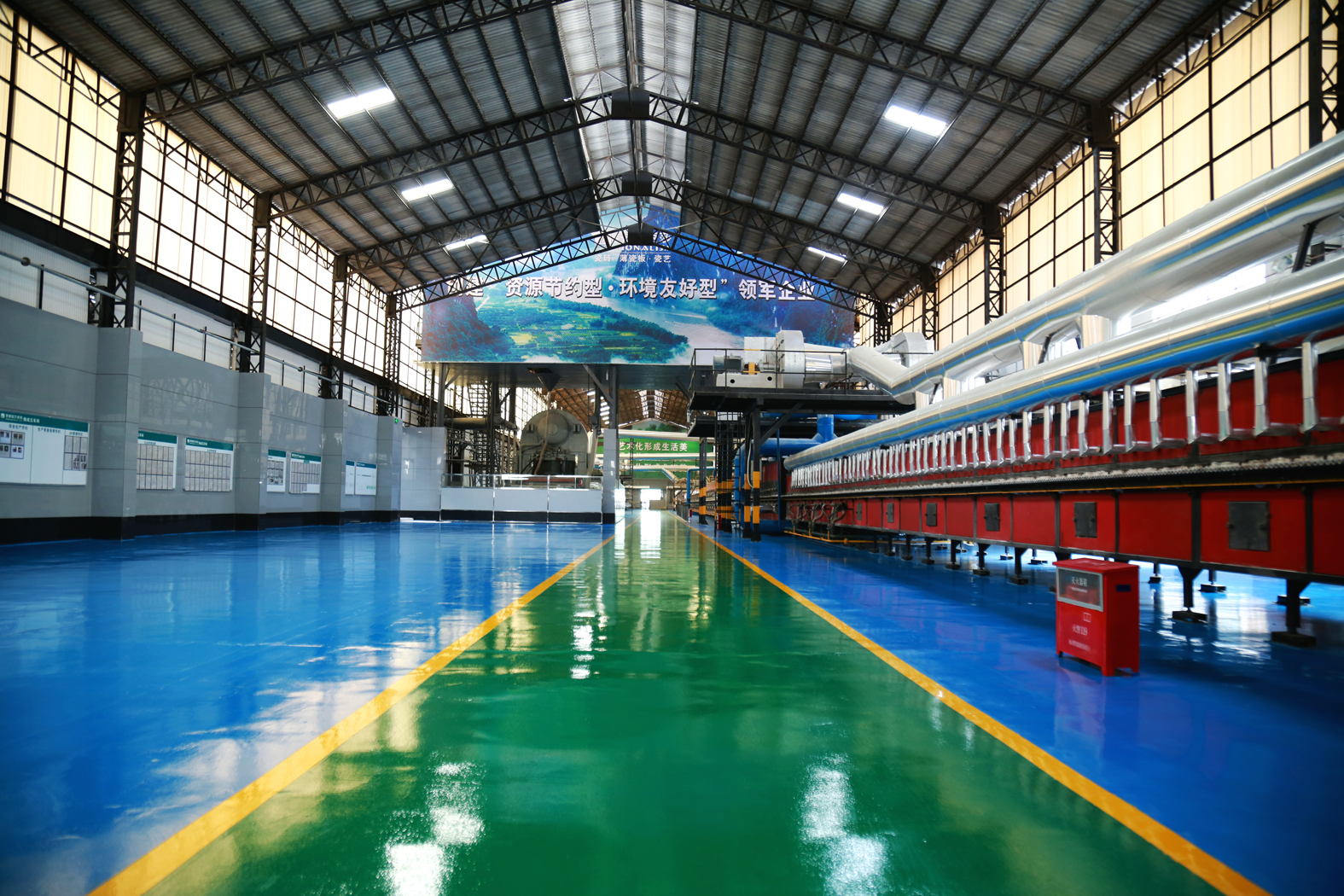
Monalisa Group Co., Ltd. (Monalisa) is a Foshan-headquartered architectural ceramics company whose reported manufacturing network includes four production bases and 37 production lines. The company profile lists a total factory area of 2,779,333.33 m²—approximately 2.78 million m². For buyers evaluating large-format sintered stone slabs, these figures describe the scale of the wider group’s manufacturing footprint; they do not, by themselves, establish sintered-stone-only capacity, utilization, or the output available for a particular order.
That distinction is central to interpreting manufacturing scale. A large site area and multiple production lines can help buyers understand the supplier’s broader industrial context, but they cannot substitute for product-specific capacity evidence. The available product information provides more direct screening details: Monalisa lists slab formats including 900 × 2700 × 9 mm and 900 × 2700 × 12 mm. Buyers can therefore assess the stated dimensions alongside their own design, fabrication, transport, installation, and compliance requirements—while treating the group-level figures as context rather than a production guarantee.
What the scale figures establish—and what they do not
The four-base, 37-line network is a useful first description of Monalisa’s manufacturing footprint. Its four named bases are in Xiqiao (Foshan), Qingyuan (Guangdong), Tengxian (Guangxi), and Gao’an (Jiangxi). The reported 2,779,333.33 m² factory area is a group-level area figure. It should not be read as annual output, usable slab area, or the amount of production space assigned to sintered stone.
The distinction matters because the company’s broader portfolio includes architectural ceramic products beyond sintered stone slabs. The company profile describes ceramic tiles, ceramic slabs—including thin plates, large plates, and rock plates—and porcelain art paintings. It does not allocate the 37 lines or the total factory area by product category. Nor does the available information identify which base produces a particular slab model. As a result, using the network figures as proof of a dedicated large-format sintered stone capacity would go beyond the documented evidence.
| Reported item | What it supports | What it does not establish |
|---|---|---|
| Four production bases | The group operates a multi-base manufacturing network at the four named locations. | Which base makes a specific slab, or the production allocation by product. |
| 37 production lines | The company profile reports 37 lines across the group’s bases. | How many lines are dedicated to sintered stone, their utilization, or their current available capacity. |
| 2,779,333.33 m² factory area | A reported group-level factory-area figure, approximately 2.78 million m². | Annual output, slab-specific floor space, or order availability. |
| 900 × 2700 mm slab listings | Specific listed product formats that buyers can compare with project drawings. | Performance characteristics or certification for every size and model. |
For procurement teams, this is not a reason to disregard scale information. It is a reason to use it correctly. The network figures help establish the size and geographic spread of the company’s manufacturing organization. Order planning still requires model-level confirmation: product availability, production location, batch planning, packing configuration, delivery schedule, and the technical documents applicable to the exact item.
Large-format slabs: begin with the dimensions on the product listing
Monalisa’s supplied product records include two large-format listings relevant to a format review. The model 90-270DBY09340M, described as Flowing light Sintered Stone, is listed at 900 × 2700 × 9 mm with a glazed-matt finish. The models 90-270FDK09003M/90-270FDK09008M, described as Luxury Slab, are listed at 900 × 2700 × 12 mm with a glazed-matt finish. Both listings identify clay/quartz sand as the material.
These are catalogue-level facts, not a complete technical specification. They give a buyer a starting point for checking whether a stated size and thickness align with the intended design. They do not, on their own, establish bending strength, tolerances, slip rating, thermal performance, stain resistance, or suitability for every countertop, floor, wall, or exterior application. Those decisions require the technical data and test evidence for the exact model and intended use.
The larger dimensions can affect how a project is detailed and executed. Before selection, project teams generally need to coordinate the slab layout with access routes, lifting and handling arrangements, cutting plans, substrate preparation, joint design, and installer capability. These are practical planning questions rather than performance claims about a particular product. A buyer should confirm the relevant handling and fabrication instructions with the supplier and the installation team, especially where the design depends on continuous visual surfaces or site cutting.
Format selection also affects the relationship between design intent and installation conditions. A large panel may support a different visual layout from smaller individual units, but the result depends on the approved design, the specified slab, fabrication accuracy, site conditions, and workmanship. A product’s nominal dimensions alone do not guarantee a particular visual outcome or installation saving.
How the manufacturing network relates to a project order
A multi-base network and a broad line count are relevant background when a buyer is screening a manufacturer, but a project order is fulfilled through product-level decisions. The buyer needs to connect the requested model and finish to a confirmed production plan. That means checking whether the quoted item is the exact model, whether the required quantity and batch can be supplied, and whether the supplier has confirmed the schedule for the destination and project requirements.
Where an order includes multiple sizes, thicknesses, or finishes, the project team should also verify that each item is covered by the same or separately documented technical information. A product family name does not automatically make every variant equivalent. Model references, dimensions, surface descriptions, and document scopes should remain aligned across the quotation, technical submittal, sample approval, packing list, and purchase order.
Monalisa’s company profile describes production bases in four locations, but it does not assign individual slab models to those sites. Buyers should therefore ask the supplier to identify the planned production location for the quoted product rather than infer it from the group footprint. Similarly, the total of 37 production lines should not be treated as a promise that a particular number of lines is available for a project or that a requested quantity can be produced within a given period.
Certification is product- and scope-specific
The supplied CE documentation identifies a Slab product under certificate number CY25A10378, issued by China Testing & Certification International Group Shaanxi Co., Ltd. The documented scope is a 900 × 1800 × 10 mm slab, classified as B I a, with a glazed, even surface for wall and floor use, in accordance with EN 14411:2016. This provides a concrete document reference for buyers reviewing that stated scope.
It should not be presented as proof that every Monalisa large-format slab is covered. The 900 × 1800 × 10 mm scope is distinct from the catalogue listings at 900 × 2700 × 9 mm and 900 × 2700 × 12 mm. Buyers evaluating either of those larger formats should check the applicable documents for the exact model and intended use. The certificate information available here does not establish that the two 900 × 2700 mm listings share the same certification scope.
This is an important boundary for projects with formal submittal requirements. A CE reference is useful only when the product, dimensions, intended application, and supplied documentation match the project’s specification. The name “Slab” alone is not enough to establish that two products have identical scope. Procurement teams should retain the certificate and related product records with the approved model details, and confirm any destination-market requirements through the project’s compliance process.
Applications should be matched to evidence, not inferred from keywords
Large-format sintered stone slabs are often considered for architectural surfaces, but the product information provided for Monalisa should be used at the level it supports. The 900 × 2700 mm catalogue entries establish listed formats and finishes. The separate CE scope establishes a specified 900 × 1800 × 10 mm product for wall and floor applications. These records do not prove every listed format is appropriate for every kitchen countertop, bathroom vanity, wall cladding, flooring, or exterior façade installation.
For a kitchen countertop or vanity, the project team should confirm that the precise model is intended for the proposed fabrication and use, then review the relevant technical documentation and installation guidance. For wall cladding or flooring, the buyer should verify the product’s approved application, substrate and fixing requirements, and any performance criteria set by the project. Exterior use may introduce additional design and compliance requirements; the available format listings alone do not establish suitability for a façade system.
Search terms such as scratch resistant, heat resistant, stain resistant, waterproof, UV resistant, or fireproof should not be treated as verified product claims in the absence of model-specific test evidence. The available records do not provide test results for those performance properties for the 900 × 2700 mm models. A careful buyer should request the applicable reports rather than transfer a general category expectation to a particular slab.
Similarly, labels such as NSF certified, CE certified, or eco friendly need to be tied to a particular item and document scope. For the evidence in this article, the CE information is limited to the identified 900 × 1800 × 10 mm Slab scope. No conclusion about NSF coverage, fire classification, or environmental certification for the listed 900 × 2700 mm models can be drawn from the provided product records.
What a project reference can—and cannot—show
A supplied project record describes an 80,000 m² large-format tile delivery for a Sri Lankan government-related convention project, with 900 × 1800 mm products used across indoor and outdoor areas. The record reports that the format helped reduce visible joints and describes on-site technical support during installation. This is relevant as an example of large-format material being used in a substantial public-project setting, but it is not evidence that the 900 × 2700 mm catalogue models were used there.
The project record can inform the questions buyers ask about handling and installation support. It cannot establish production output for a particular base, line utilization, or the supplier’s capacity for a future order. Nor should the reported project outcomes be generalized to a different model, site, climate, installation system, or contractor team without matching evidence.
For a new project, the reference is best used as a prompt for a more specific discussion: what product and dimensions were supplied, what installation assistance was available, which technical documents were used, and how the supplier coordinated delivery with the local contractor? Those questions help distinguish documented project experience from assumptions based solely on a large factory footprint.
Comparison with smaller-format tile: a useful distinction, not a blanket verdict
Compared with smaller-format tile, a large-format slab changes the unit size and the way a surface can be laid out. The Sri Lanka project record provides one project-specific example: it reports fewer visible joints for its 900 × 1800 mm format. That observation should remain attached to that project and format; it is not a universal quantified result for every slab installation.
Large-format panels also have practical boundaries. Their dimensions can make transport through the building, handling, cutting, installation access, and breakage planning more consequential than for smaller pieces. A project may need suitably experienced fabricators and installers, and a design may require careful coordination of seams and cut-outs. Smaller-format materials can be easier to handle in some site conditions or detail-heavy layouts. The better choice therefore depends on the project’s design, logistics, installation capability, and documented product suitability—not simply on which format appears larger or more seamless.
For Monalisa buyers, the comparison should be made between a specific slab model and a defined alternative. The available evidence does not provide a general cost comparison, a breakage comparison for the listed 900 × 2700 mm models, or a universal installation-time advantage. Those points should be assessed using project quotations, product documents, installation plans, and the relevant contractor’s method statement.
A practical evidence checklist for evaluation
| Evaluation question | Evidence to request or confirm |
|---|---|
| Which slab is being quoted? | Exact model number, dimensions, thickness, finish, and approved sample. |
| Does the document match the product? | Certificate and test-report scope checked against the model, dimensions, surface, and application. |
| Where will the order be produced? | Written confirmation of the production location and the planned order schedule; do not infer this from the four-base network. |
| Can the project handle the format? | Coordinated access, lifting, cutting, substrate, fixing, and installation plans for the specified slab. |
| Are performance claims substantiated? | Model-specific test evidence for any required resistance, safety, or environmental property. |
| Is supply confirmed for the required quantity? | A project-specific quotation and written confirmation of quantity, batch, packing, and delivery schedule. |
This checklist separates corporate scale from order-level evidence. It also reduces a common evaluation risk: treating group-wide manufacturing figures as if they were a technical specification or a binding commitment for an individual project.
Market context and future outlook
Large-format sintered stone slabs sit at the intersection of product specification, fabrication, logistics, and architectural design. For buyers, the practical evaluation task is not simply to identify a manufacturer with a large network. It is to establish whether the specific format, finish, documents, production plan, and installation conditions align with the project.
The available evidence does not establish a market-wide demand trend, a sintered-stone-specific capacity figure for Monalisa, or a dedicated line count for large-format slabs. Accordingly, the four bases, 37 lines, and approximately 2.78 million m² should be understood as a snapshot of reported group manufacturing scale—not as a forecast of future slab supply or a market-share indicator. Future procurement decisions will remain stronger when they are based on current, product-specific capacity and compliance documents, rather than extrapolations from broad company-level figures.
For evaluation-stage buyers, the clearest takeaway is twofold: Monalisa’s reported network offers context on the scale of its wider manufacturing organization, and its product listings provide specific large-format dimensions to screen against project needs. The next step in a sound technical review is to connect those listings to current availability, model-specific performance evidence, certification scope, and confirmed production scheduling. That is the point where a general manufacturing profile becomes useful procurement information.
FAQ
What does Monalisa’s 2.78 million m² figure represent?
It is an approximation of the reported group factory area of 2,779,333.33 m². It is not an annual production figure or a stated sintered-stone-only capacity.
How many production bases and lines are reported?
Monalisa’s company profile reports four production bases—in Xiqiao, Qingyuan, Tengxian, and Gao’an—and 37 production lines across the group. The available information does not specify how many lines are dedicated to sintered stone.
Which large-format slab dimensions are listed?
The supplied catalogue records list 900 × 2700 × 9 mm for model 90-270DBY09340M and 900 × 2700 × 12 mm for models 90-270FDK09003M/90-270FDK09008M.
Does the CE document cover the 900 × 2700 mm listings?
The provided CE scope identifies a 900 × 1800 × 10 mm Slab product for wall and floor use. The available information does not establish that this scope covers the separate 900 × 2700 mm listings.
¿Tiene preguntas o necesita más detalles?
Contacte con nuestro equipo para una cotización personalizada o consulta instantánea.
Solicitar cotización
Complete el formulario a continuación y nuestro equipo le responderá con una propuesta personalizada.
Chat directo de WhatsApp
¿Prefiere chatear en tiempo real? Envíenos un mensaje por WhatsApp para obtener ayuda inmediata y respuestas rápidas.
- Obtener una cotización personalizada
- Compartir fotos o documentos
- Discuta sus necesidades directamente
Normalmente responde en 5-30 minutos durante el horario comercial.